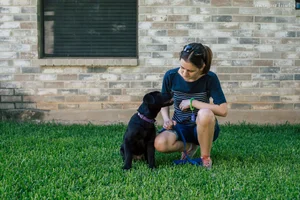
Whose fault is it?
If your dog makes a mistake, is “naughty,” or “disobeys,” whose fault is it? His or yours?
As a positive-reinforcement, reward-based dog trainer, I believe one of the things that sets me apart from traditional or punishment-based dog trainers is that I believe the dog’s mistakes are my fault.
Or, if not strictly my “fault,” they are, at least, my responsibility.
What does that look like and why does it matter?
Consider jumping.
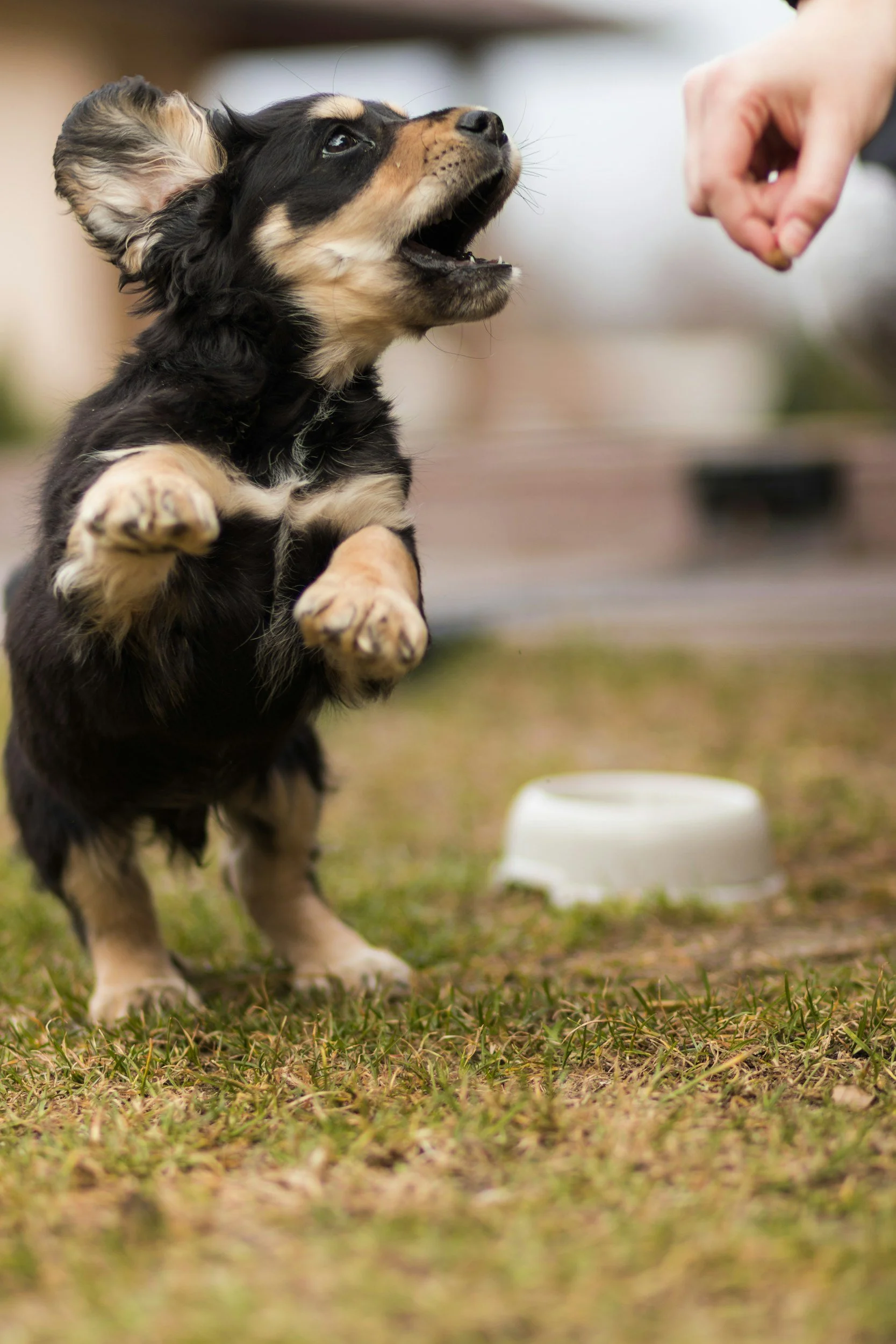
How should we respond when the puppy makes a mistake?
When a dog jumps on me, if I believe that mistake is my “fault,” then it also becomes my responsibility to change something about what I’m doing in order to fix the problem. I am the “wrong” one.
But if I believe the jumping is entirely his fault, then I think there’s a subconscious expectation that he’s the one that needs to change because he’s the one with the problem.
The difference between these two mindsets is subtle, but I believe they influence how we approach resolving behavior problems in our dogs.
When your dog makes a mistake, who has done something wrong? You or your dog?
So the dog is never wrong?
Not necessarily.
Taking responsibility for the dog’s mistakes does not mean that I never have a problem with the dog’s behavior, or that I never try to change it. The jumping dog can learn to keep his feet on the floor. (After all, as a professional dog trainer, I have a job because there is both the need and ability to change dog behavior.)
But, I believe that both ends of the leash need to participate and compromise to have a good relationship and enjoy an easier life together.
Much like human-human relationships, when problems arise, both parties both can take steps towards a solution because both parties contributed to the problem. It’s rarely one sided.
Of course, dogs depend on us to help them take those steps. When I take responsibility for a dog’s mistakes, his errors move from being cues to correct him, to cues to change my own behavior or the conditions in the environment.
I am his teacher so his mistakes are as much my “fault” as his successes.
Incidentally, by looking, first, at what I can change in myself and the environment, I wind up getting faster relief!
For more on this topic, check out this episode of Sarah Stremming’s podcast.
Meet the Dog Trainer and Blog Author
Leighann Hurley founded Koinonia Dogs in 2014 and has been a Certified Professional Dog Trainer in the Austin,TX area since 2019.
She's a problem-solver by nature and loves creating cooperation through conflict-free communication so both ends of the leash enjoy an easier life together.