How to Gain Your Puppy’s Trust
I’ve been working as a dog trainer since 2014, but I often forget about the relationship aspect of training.
I don’t know if it’s because I’m Type-A, but when I think about solving a problem or teaching a behavior, I’m skills and process-focused. “If I just do Step #1, Step #2, and Step #3, voila! The puppy will be trained.”
But there’s another Step that’s harder to fit into a neat box: the relationship. A good relationship supports training. A sour relationship hinders it.
This is particularly important to remember when we’re bringing a new puppy (or dog) into the family.
What does your puppy think about you? Does she know you? Does she trust you?
Here are three ways you can gain your puppy’s trust and lay a foundation for a great life together.
#1 Invite Instead of Insist
Puppies are oh-so-cute. Those little faces and squishy bodies just cry out for a cuddle sometimes.
But before you reach for a squeeze, consider this: does your puppy want to cuddle?? Does your puppy want to cuddle in that way? Does your puppy want to cuddle right now?
Have you ever been around someone who was more touchy-feely than you? I have. It made me extremely uncomfortable. I didn’t even want to be in the same room as them.
The same thing can happen with your puppy.
Never forget that you are, initially, a perfect stranger to your puppy. When you bring him home, he’s a bit confused and anxious, and having his personal space invaded by a stranger isn’t necessarily going to make it better.
When it comes to petting and cuddling your puppy, think “Invite Instead of Insist.”
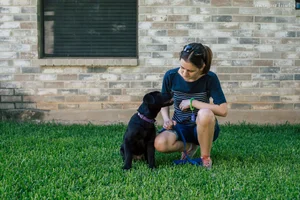
Instead of going up to your puppy and Insisting that it’s petting time, Invite her by taking a couple of steps away and kneeling down.
If she keeps her distance, respect that. You are more likely to get a “yes” in the future if you slow down now and show her that you are trustworthy — you see what she’s saying and you listen.
If she comes closer for a cuddle, enjoy the time but give her plenty of chances to be done. Especially in her first few weeks home.
Bonus: this concept can be applied to lots of different situations — not just petting. Watch me do it with Australian Shepherd, Kal, when it’s time to put on his collar.
#2 Trade Instead of Take
Puppies like to put their mouths on just about everything. Even if you do everything right to puppy proof your home, your puppy is going to wind up with something she shouldn’t have.
If you need to remove the item, think “Trade Instead of Take.”
Try this instead of chasing after your puppy, and prying her mouth open (a recipe for future Keep Away and Resource Guarding!):
Go get some super yummy treats
Calmly approach her
Toss the treats several feet away
Once she’s dropped her treasure and gone for the treats, remove the item
Watch me do it with these two German Shepherds.
“But won’t this teach her to grab stuff for treats??” Maybe. But I’d rather have a dog who helps me clean up and eagerly release the items, than one who grabs stuff and gets aggressive when I try to remove it.
Note: if your puppy is already running away with items, freezing, trying to consume them faster, snarling, snapping or biting when you try to approach, please contact a qualified fear-free, positive-reinforcement professional ASAP.
#3 Be Consistent
News flash: puppies don’t speak English. That means the only ways they learn about their new world — our world — are through observation, association and consequences.*
The more consistent you are in your movement, expectations and communication, the better they understand.
Consistency is about showing your puppy that you are a safe human she can count on. Not an unpredictable giant.
Cultivate your puppy’s trust by being consistently gentle, compassionate and clear.
*In dog training, consequences aren’t inherently negative, yucky things. Instead, they are whatever happens immediately after a behavior. Getting a treat for sitting is a consequence.
Meet the Puppy Trainer and Blog Author
Leighann Hurley founded Koinonia Dogs in 2014 and has been a Certified Professional Dog Trainer in the Austin, TX area since 2019.
She's a problem-solver by nature and loves creating cooperation through conflict-free communication so both ends of the leash enjoy an easier life together.